I just discovered that the old issues of Access to Energy, the wonderful pro-nuclear, pro-science, pro-technology, pro-free enterprise newsletter formerly published by the late, great Dr. Petr Beckmann are online. Beckmann was a brilliant electrical engineering professor and libertarian who died of cancer in 1993 (see his poignant, “Goodbye, Dear Readers“).
Update: Thorium: The Ultimate Alternative Energy.After his death, AtE was taken over by Dr. Art Robinson, who also, I believe, is a proponent of home-schooling. Beckmann wrote the intriguing book Einstein Plus Two (Amazon), and founded, with physicist Howard Hayden, the dissident physics journal Galilean Electrodynamics (brochures and further Beckmann info here; further dissident physics links). Hayden later began to publish his own pro-energy newsletter, The Energy Advocate.
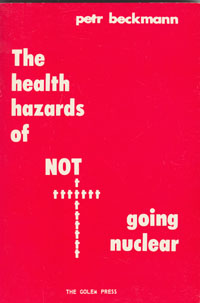
One of Beckmann’s most important works–and one sorely in need of revision and republication today, in view of the continued strangling of nuclear power and the irrational push for “soft” energy–is his The Health Hazards of NOT Going Nuclear (Amazon; PDF). See also his pamphlets The Non-Problem of Nuclear Waste and Why “Soft” Technology Will Not Be America’s Energy Salvation.


{ 13 comments }
Given that the Austrian school is sometimes unfairly dismissed as “crank economics”, I’d suggest distancing yourself from actual crank science. These sorts of publications have a long and (ig)noble history, especially when it comes to attacking Einstein’s relativity. Though Galilean Electrodynamics and its ilk would make for some interesting problems in a freshman relativity course (i.e., “find the error in…”), their use doesn’t extend much beyond that. (This happens to be one of my areas of expertise; I taught freshman physics, including relativity, at Caltech for five years. I’d be thrilled to find an actual error in relativity, by the way; there’s a committee in Sweden that would likely contact me shortly thereafter.)
Michael Hartl:
A bit off topic, but I’m curious as to your thoughts on Hoppe’s criticisms of general relativity and quantum mechanics (admittedly from a philosophical/foundational basis, as opposed to a mathematical/technical basis).
Could you quote Hoppe’s attack on it? Neither Mises nor Hoppe dismiss it so far as I can recall, though in Mises’s case he did dismiss certain interpretations of it (I wonder what his brother thought on the matter.)
This is interesting, Stephan; thanks.
I agree with Beckmann that coal poses health threats (in mining, transporting, burning and sludge disposal) magnitudes greater than does nuclear. While enviro opposition to nuclear has had regrettable consequences, such opposition is understandable given the close intertwining of the nuclear power business with the state – which continues to provide caps on liability, and damages the industry by preventing preporcessing and interfering in waste disposal.
As for Dr. Robinson, he is worthy of note chiefly in his role in providing the vehicle for a deliberately deceptive petition project regarding climate change:
http://en.wikipedia.org/wiki/Oregon_Petition
Inquisitor:
Unfortunately my books are all in boxes (I’m in the middle of a move), but Hoppe’s critique is essentially, if one necessarily presupposes the validity of concepts like causality or Euclidean geometry, then it cannot be said that fields of modern physics (which also presuppose these concepts) have falsified them (as one often hears said of quantum mechanics and general relativity).
Stephan, can you dig up any quotes?
As I discuss in More Palmer Hoppe Distortions, on The Palmer Periscope:
***
As for geometry and optics, it seems Palmer did not hear Hoppe clearly. I do not believe he stated "that Ludwig von Mises had laid the foundation not
only for economics, but for ethics, geometry, and optics". Rather, as shown in On Praxeology and the Praxeological Foundation of Epistemology (text at notes 60-62, and note 62; from Economic Science and the Austrian Method)), which references Lorenzen, Dingler, Karnbartel, et al., regarding an entire body of "protophysics" –
So Palmer is wrong. Hoppe did not claim Mises "laid the foundation not only for economics, but for ethics, geometry, and optics"; and does Palmer want to relegate to the dustheep in a wave of the hand thinkers like Lorenzen et al.?! This is a standard branch of apriori reasoning. Palmer may not agree with it, but so what?
One of the chapters in A Theory of Socialism and Capitalism has an outstanding discussion of causality as a necessary presupposition for carrying out experiments (in the sense of being able to characterize the outcomes as “testing” a physical theory), not something that is itself only empirically true.
Tom Palmer is clearly suffering from dementia, and not the kind brought on by old age.
Regarding Hoppe’s position on geometry: the world is Euclidean to high accuracy, but there are measurable deviations from Euclidean geometry at high speeds and in high gravitational fields. Our intuition is Euclidean because humans evolved deep in the Newtonian/Euclidean realm of physics, but our untrained intuition is wrong outside of that realm.
The claim that engineering and even measurement itself presuppose Euclidean geometry is false. The meter is defined in terms of light travel time (a meter is the distance light travels in vacuum in 1/299792458 s), with no reference to rigid bodies or any other Euclidean constructs. And an engineered system many of us use every day depends crucially on non-Euclidean effects: without the time dilation corrections from special and general relativity, the Global Positioning System would be useless within a day. (For more information on these and related issues, I recommend Spacetime Physics by Taylor & Wheeler.)
There is no fundamental barrier to economists doing physics, but without training they will be as bad at physics as the typical physicist is at economics—and, having seen many physicists try to do economics, I can testify that that is very bad indeed.
Michael Hartl:
You mentioned you taught at Caltech? I went there as an undergrad (MIT for grad school), so I assure you I understand the underlying technical mathematics of modern physics. These are irrelevant to Hoppe’s point, which I’m afraid you didn’t grasp (perhaps you are relying on my rather sketchy synopsis, rather than Hoppe’s original writings?).
@Dan: yes, I was relying on your summary. I am otherwise unfamiliar with Hoppe’s views on physics.
Interesting discussion — Dan Mahoney — been looking for you for years (Caltech undergrad roomie) — send me an email – kevin@kevcat.com
That was a frankly amazing read!
Comments on this entry are closed.