

Recently, I took up reading Michel Foucault‘s Discipline and Punish, published in 1975. The most interesting part is the chapter on panopticism. Panopticism is a social theory of power, and how power structures evolve and spread throughout society. The name is derived from Jeremy Bentham‘s “Panopticon“. Bentham’s Panopticon was meant to be built. Foucault adopts it as an ideal type as a means of describing the characteristics of power relationships.
The conclusions Foucault reaches are certainly questionable, and I do not intend to comment on this particular aspect of Foucault’s work. However, I think his description of the apparatus of power should be seriously considered.
The Panopticon is a building based around a central tower, with several large windows facing away from the center. The tower is occupied by what we can consider guards. Around this tower is a periphery building, composed entirely of cells. Each cell holds one individual, and there is no method of communication between cells. There are two windows per cell: one facing the outside (so that those on the outside can see what is occurring 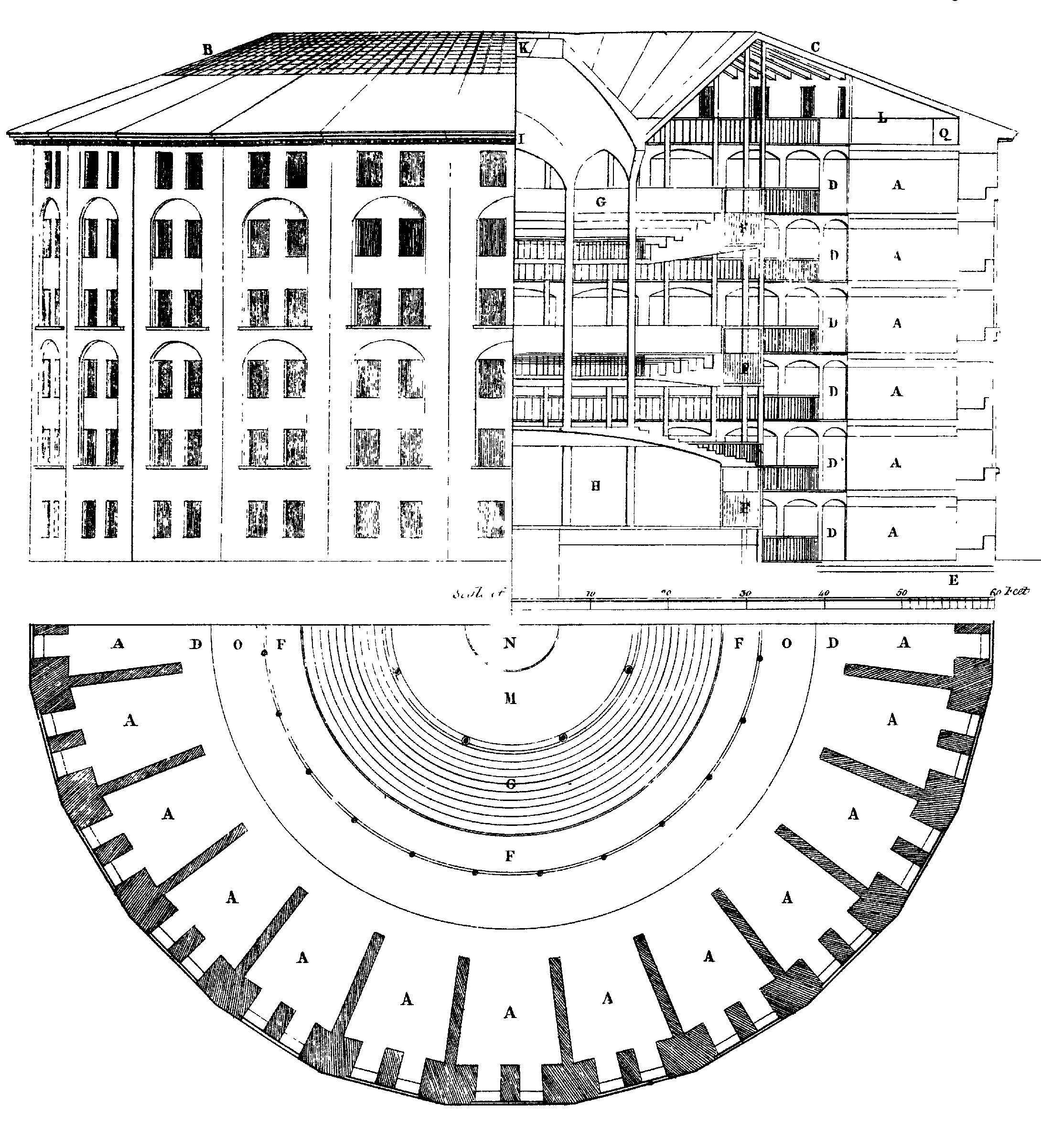 inside the Panopticon) and another facing the inside. The tower’s windows line up with the inside windows of the periphery building, allowing the guards to see everything each individual cellmate is doing. However, while the guards can see the inmates, the inmates cannot see the guards (imagine, then, a reflective glass).
Writes Foucault,
The panoptic mechanism arranges spatial unities that make it possible to see constantly and to recognize immediately. In short, it reverses the principle of the dungeon; or rather of its three functions — to enclose, to deprive of light and to hide — it preserves only the first and eliminates the other two. Full lighting and the eye of a supervisor capture better than darkness, which ultimately protected. Visibility is a trap.
The purpose of the Panopticon is not just to isolate the subjects. Rather, it is to keep track of and ultimately control the actions of the cellmates. “Visibility is a trap” in the sense that the prisoners know they are being watched.
Hence the major effect of the Panopticon: to induce in the inmate a state of conscious and permanent visibility that assures the automatic functioning of power.
Authority is “visible”, but not “verifiable”. In other words, the cellmates know that on the other side of their cell’s inner window there is an authority, yet the concept of authority remains aggregated. They cannot put a face to those who are wielding power. Thus, authority is not verifiable.
That it is not verifiable is important, as Foucault explains,
It is an important mechanism, for it automatizes and disindividualizes power. Power has its principle not so much in a person as in a certain concerted distribution of bodies, surfaces, lights, gazes; in an arrangement whose internal mechanisms produce the relation in which individuals are caught up. The ceremonies, the rituals, the marks by which the sovereign’s surplus power was manifested are useless. There is a machinery that assures dissymmetry, disequilibrium, difference. Consequently, it does not matter who exercises power. Any individual, taken almost at random, can operate the machine: in the absence of the director, his family, his friends, his visitors, even his servants(Bentham, 45). Similarly, it does not matter what motive animates him: the curiosity of the indiscreet, the malice of a child, the thirst for knowledge of a philosopher who wishes to visit this museum of human nature, or the perversity of those who take pleasure in spying and punishing. The more numerous those anonymous and temporary observers are, the greater the risk for the inmate of being surprised and the greater his anxious awareness of being observed. The Panopticon is a marvellous machine which, whatever use one may wish to put it to, produces homogeneous effects of power.
A real subjection is born mechanically from a fictitious relation. So it is not necessary to use force to constrain the convict to good behaviour, the madman to calm, the worker to work, the schoolboy to application, the patient to the observation of the regulations. Bentham was surprised that panoptic institutions could be so light: there were no more bars, no more chains, no more heavy locks; all that was needed was that the separations should be clear and the openings well arranged.
Foucault’s point: who wields the power is irrelevant. That power does not originate from particular characteristic of the individual. Rather, the power relationship is established by the apparatus.
As aforementioned, he comes to the conclusion that this is the power relationship that develops in any hierarchical system which is meant to constrain the behavior of of those within the system. He gives schools, hospitals, and factories as examples. Regarding this particular aspect of Foucault’s theory, I leave you to come to your own conclusions (although, I would keep in mind that there are differences in ability between a private institution [since these do not have a monopoly on force] and the state in forcing people into these types of relationships). But, when applied to the state, I think Foucault’s “Panopticon” provides us a pretty good vision of how it operates and its relationship with you.
An end to the state requires the dismantling of its particular apparatus of power.
